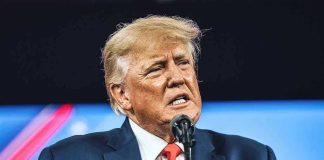
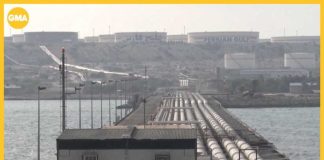
President Trump’s decisive action to protect American interests and global energy security stands in stark contrast to the regime in Tehran threatening to strangle the world’s most critical oil chokepoint.
Story Snapshot
- Iran’s Revolutionary Guard effectively shut down the Strait of Hormuz after U.S.-Israeli strikes, halting 20% of global oil trade and spiking prices
- Trump ordered immediate political risk insurance through the U.S. Development Finance Corporation and hinted at Navy escorts to reopen shipping lanes
- Energy markets face potential crisis as shippers refuse passage despite federal guarantees, citing safety concerns in the narrow 21-mile waterway
- Experts question whether Trump’s economic tools alone can overcome shipper reluctance without full military engagement to clear Iranian threats
Iranian Aggression Threatens Global Energy Markets
Iran’s Revolutionary Guard Corps closed the Strait of Hormuz to all traffic following coordinated U.S. and Israeli strikes over the February 28-March 1 weekend. The closure halted approximately 20 million barrels per day—roughly one-fifth of global oil trade—sending prices to their highest levels in over a year. The IRGC simultaneously attacked energy infrastructure across the Gulf region, targeting facilities in the UAE and Oman. This strategic chokepoint, just 21 miles wide at its narrowest point, serves as the primary artery for Middle Eastern oil exports to Asian markets.
Trump Administration Responds With Financial Guarantees
President Trump met with Energy Secretary Chris Wright and Treasury Secretary Scott Bessent on March 3, immediately posting on Truth Social his directive for the U.S. Development Finance Corporation to provide political risk insurance at reasonable prices. The announcement promised guarantees “effective immediately” to restart oil flows and maintain what Trump described as “the free flow of energy to the world.” Treasury Secretary Bessent indicated additional announcements would follow, signaling a comprehensive approach to the crisis. The administration’s rapid response aims to stabilize markets while projecting American strength against Iranian hostility without the weakness that characterized prior administrations.
Shipping Industry Remains Skeptical of Federal Protections
Despite Trump’s financial assurances, oil shippers have not resumed passage through the strait, citing safety concerns that federal insurance cannot adequately address. Lloyd’s of London deemed the administration’s plan unclear and warned that Navy escorts might actually heighten risks rather than reduce them. Shipping executives prioritize protecting seafarer lives and avoiding potential environmental disasters in the narrow waterway, where a single strike could create catastrophic consequences. Insurance premiums have soared beyond what the DFC guarantees cover, leaving a gap between federal promises and industry willingness to risk valuable vessels and crews in what remains an active conflict zone.
Economic and Strategic Implications Mount
Oil prices stabilized slightly following Trump’s announcement but remain vulnerable to further spikes if the closure extends beyond two weeks. Rystad Energy analyst Claudio Galimberti warned that the strait functions as “the big artery” of global energy markets, with continued conflict threatening severe price increases. The situation complicates Trump’s campaign promises to deliver low gas prices to American consumers, as prolonged disruption would feed directly into domestic inflation. Military analysts predict U.S. naval forces could clear Iranian threats within weeks if fully engaged, though such action risks broader regional conflict that would further destabilize markets and potentially trigger Iranian retaliation against allied infrastructure.
Historical Context Reveals Pattern of Iranian Tactics
Iran has threatened Strait of Hormuz closures repeatedly since 2019, when the IRGC conducted drone and mine attacks on tankers during the U.S. “maximum pressure” campaign following withdrawal from the nuclear deal. The current crisis follows Operation Midnight Hammer in June 2025, which destroyed Iranian nuclear facilities after failed negotiations. The regime’s strategy mirrors tactics from the 1980s Tanker War during the Iran-Iraq conflict, when Tehran routinely targeted commercial shipping to leverage its geographic position. However, Iran risks significant self-harm through export losses, as the closure prevents its own oil shipments while accomplishing little beyond temporary supply shocks that ultimately strengthen arguments for American energy independence.
The Trump administration’s approach balances economic tools with implied military backing, offering shippers the support needed to resume operations while maintaining pressure on Tehran. Experts remain divided on whether financial guarantees alone will suffice or whether full naval intervention becomes necessary to restore the 20 million barrels per day flowing through this critical waterway. What remains clear is that American leadership—not empty diplomatic gestures—provides the only credible path to reopening global energy flows and protecting both domestic consumers and international commerce from Iranian aggression that threatens the world economy.
Sources:
Washington Examiner: Trump offers assistance to oil shippers amid price spike, Iranian threat
Business Insider: Trump US oil price stock market energy Iran commodity war
Sky News: Trump’s solutions to Iranian shipping threat leave insurance sector unimpressed