When America’s top diplomat brands communist revolutions “godless” and blames them for erasing Western courage and culture, it exposes how the people in charge still fight old ideological wars instead of fixing the broken system at home.
Story Snapshot
- Marco Rubio uses a major global stage to condemn communism as a “godless” threat to Western values.
- He ties communist movements to Western decline, mass migration, climate policy, and lost factory jobs.
- Critics call his history “revisionism” and say his rhetoric serves powerful political and corporate interests.
- The speech fits a long U.S. pattern of using anti-communist language to justify foreign policy choices.
Rubio’s sweeping attack on communism and Western decline
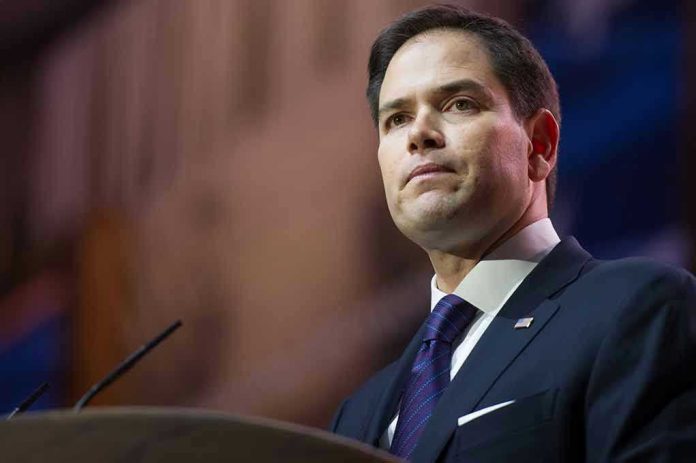
At the Munich Security Conference, Secretary of State Marco Rubio told European leaders that Western empires began to fall after World War II, pushed faster by “godless communist revolutions” and anti-colonial movements across the globe. He warned that these revolutions did not just redraw borders. In his view, they helped strip away courage, creativity, ambition, heroes, and glory from Western civilization, leaving societies unsure of who they are and what they stand for. This is not a minor claim; it paints communism as a direct assault on the very traits many Americans feel they are losing.
Rubio also linked today’s economic and social pain to past “dogmatic” choices that he says opened the door to communist-aligned systems. He argued that Western leaders embraced a rigid belief in free and unrestricted trade, while rivals protected their industries and used cheap or coerced labor to outcompete American workers. In his narrative, this helped close factories, send millions of working and middle-class jobs overseas, and hand control of key supply chains to hostile governments. Many frustrated Americans, left and right, hear echoes of their own worries about deindustrialization and lost opportunity in this story.
China, “slave labor,” and civilizational values
In his confirmation hearing, Rubio went further, calling the Communist Party of China the most “potent and dangerous near-peer adversary” the United States has ever faced. He tied that danger not only to military power, but also to human rights abuses, charging that communist-aligned systems rely on “slave labor” to make goods cheaply while creating what he called horrific humanitarian crises. In Munich, he framed his foreign policy around national sovereignty, mutual self-interest, strong militaries, and “foundational civilizational values,” setting these clearly against communist ideology and globalist institutions he says ignore real-world costs. For many Americans, this language taps into anger about unfair trade, exploited workers, and leaders who seem more loyal to distant organizations than to their own people.
Rubio’s speech also attacked what he called a “climate cult” and mass migration, arguing that Western governments followed extreme environmental rules and opened borders in ways that weakened their own societies. He said rivals freely burn oil, coal, and natural gas to grow stronger, while the West ties itself in knots over greenhouse gas limits. He blamed mass migration for threatening social cohesion, cultural continuity, and the future of Western peoples. Here again, he links communism, globalism, and elite decision-making to ordinary citizens’ daily fears about jobs, identity, and security, in a time when many feel the government is not truly on their side.
Critics push back, calling the history “revisionism”
Rubio’s harsh language did not go unanswered. Black Agenda Report, a left-leaning outlet, called his description of decolonization as part of a “sinister communist plot” an act of “historical revisionism” and an “outright lie.” Critics argue that anti-colonial movements were driven mainly by local nationalism and disgust with empire, not a single communist master plan. They say Rubio offers no primary documents or serious historical studies to show that communists centrally directed the end of European empires, and instead uses broad moral claims to fit a political agenda.
WATCH: Secretary of State Marco Rubio lays out a sweeping rebuke of communism, calling it a system that strips away everything that makes people aspire to greatness:
"Communism does not sound good in theory… The world it envisions for all of us is small, flat, gray… without… pic.twitter.com/S1K0dIn6ch
— Fox News (@FoxNews) July 16, 2026
Opponents also note logical gaps in Rubio’s argument. He blames a “dogmatic vision of free and unfettered trade” for deindustrialization and Western decline, yet communism is defined by state control of production and rejection of free markets. That makes it hard to square his attack on free trade with his attack on communism as part of the same ideological wave. Commentators at Common Dreams and Black Agenda Report frame his Munich speech as propaganda that sanitizes United States ties to right-wing dictatorships while painting all communist or leftist movements as evil. A Cuban foreign minister has publicly called Rubio dishonest and accused him of fabricating national security threats, adding to questions about his credibility on these issues.
A familiar U.S. script: anti-communism as a policy tool
Rubio’s words also fit a much older pattern in United States foreign policy. Since the Truman Doctrine in 1947, American leaders have often described communism as a moral and civilizational enemy, not just a different economic system. This language helped justify long-term military alliances, covert operations, and economic pressure across the world. In the 1980s, the Reagan Doctrine used strong anti-communist rhetoric to support rebel groups fighting Soviet-backed governments, framing these efforts as a defense of freedom and Western values. Rubio’s “godless communist” framing and his calls to “save the West” echo this Cold War script, even as everyday Americans now worry more about corruption, inequality, and lost trust at home than about distant ideologies.
Rubio’s Munich message may resonate with citizens who feel elites pushed globalism, mass migration, and climate rules while ignoring factory towns and working families. Yet both his supporters and his critics point to the same deeper problem: a federal government that seems captured by powerful interests, whether corporate, ideological, or bureaucratic. The fierce fight over his speech shows how leaders still reach for old ideological battles to rally support. Many Americans on the right and the left now ask a different question: will any of this rhetoric, anti-communist or otherwise, help rebuild a fair economy, secure borders, and a government that serves the people instead of itself?
Sources:
facebook.com, state.gov, youtube.com, rev.com, axios.com, commondreams.org, npr.org, wlrn.org, bbc.com, en.cibercuba.com