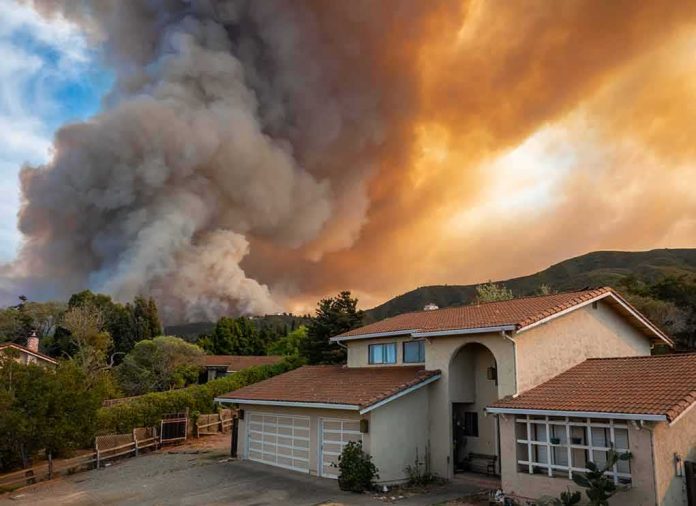
Wildfire smoke from Canada and Minnesota has once again turned the air across the Midwest and Northeast into a health threat for tens of millions of Americans.
Story Snapshot
- Heavy smoke from Canadian and Minnesota wildfires is pushing air quality into the “unhealthy” and “very unhealthy” range across large parts of the Midwest and Northeast.
- More than 100 million people are under air quality alerts, with officials warning that millions are exposed to dangerous fine particle pollution.
- State agencies and health officials urge residents, especially vulnerable groups, to stay indoors, limit exertion, and use masks and filters when possible.
- The event highlights deeper worries on both the left and right that government is not ready for a new era of chronic smoke, heat, and health risks.
Wildfire Smoke Blankets the Midwest and Northeast
Dense smoke from large wildfires in Canada and northern Minnesota is spreading over huge areas from the Great Lakes into the Northeast, turning clear summer skies into a gray or brown haze. Weather and news outlets report that smoke plumes are stretching from Minnesota and Wisconsin through Michigan and into New York and New England, with some of the thickest smoke since the infamous orange skies of 2023. In many cities, people woke up to low visibility, the smell of burning, and irritation in their eyes and throats.
National coverage describes this as a multi–day event, not a quick passing cloud. Forecasters say winds are steering smoke southeast, keeping it trapped over some of the most populated parts of the country. Air quality maps from government and private services show wide belts of polluted air stretching hundreds of miles, linking communities that otherwise have little in common except that they are downwind of fires in another country. For people already worried about the direction of the nation, it can feel like even the air is now out of their control.
Air Quality Alerts and Health Risks for Millions
Government data and media reports show more than 100 million Americans under air quality alerts as fine particle pollution from the smoke spikes well above normal. In the hardest–hit areas of Minnesota, Wisconsin, and Michigan, readings have topped the “very unhealthy” range, with some smaller communities seeing “hazardous” levels on the Air Quality Index. That means the air is not just bad for people with asthma or heart disease; it can start to harm otherwise healthy adults and children who spend time outside.
State agencies are warning residents to treat the smoke seriously, even if it looks like simple haze. Health officials in places like Michigan and Rhode Island advise people to stay indoors when they can, close windows, and run air conditioners or air cleaners on recirculate to keep smoky air out. They urge older adults, pregnant women, children, and anyone with lung or heart problems to avoid outdoor exercise, skip yard work, and use masks rated to block fine particles if they must go out. These are basic steps, but they can make the difference between mild symptoms and an emergency room visit.
Confusing Messages About “Dangerous” vs “Elevated” Smoke
One of the most frustrating parts of this kind of event is the mixed message about how bad the air really is. National headlines and private weather networks often use words like “dangerous” or “hazardous” as soon as smoke shows up, because those warnings grab attention and clicks. Yet government tools such as the Environmental Protection Agency’s Fire and Smoke Map may show many locations in the “unhealthy for sensitive groups” range instead of truly hazardous levels. That difference matters for families trying to decide whether kids can play outside or workers can safely stay on job sites.
Past smoke events in 2023 and 2025 followed a similar pattern: early talk of extreme danger, followed by more moderate but still serious readings as smoke stayed mostly aloft or shifted with the wind. This time, some spots are seeing very high numbers, but others only have elevated levels that mainly threaten people with existing health problems. The gap between loud national coverage and quieter official data feeds a wider sense that the system cares more about ratings and politics than clear guidance for ordinary people who just want straight answers.
Deeper Worries About a Government That Seems Unprepared
Wildfire smoke pouring into American cities from outside the country taps into fears shared by many conservatives and liberals: that federal leaders are not ready for long–term climate and land problems. People on the right see forests left to burn, aging power grids, and a focus on global debates instead of practical steps like better logging, brush clearing, or support for local fire crews. People on the left see rising inequality, fragile public health systems, and more pollution hitting working neighborhoods while well–connected elites escape to cleaner spaces.
As Canadian wildfire smoke affects air quality across parts of the Midwest and Northeast, people are once again relying on monitoring data to understand what they are breathing.
Yet ground monitors may not capture the full picture, especially at the neighborhood level.
Undark’s… pic.twitter.com/QHMpsjDZ28
— Undark Magazine (@undarkmag) July 16, 2026
Both sides watch repeated smoke emergencies and wonder why basic protections are still so patchy. There is no simple national program to put high–quality filters in schools and elder care centers, or to guarantee clean indoor air for low–income families stuck in older buildings. International talks about climate and energy policy move slowly while parents are told, again, to keep kids indoors and hope the wind shifts. For many Americans breathing this latest wave of smoke, the event is not just about weather; it feels like another sign that the people in charge are not living in the same world as everyone else downwind.
Sources:
washingtontimes.com, cnn.com, science.nasa.gov, cbsnews.com, wcpo.com, nbcnews.com, bloomberg.com, apnews.com, weather.gov, aljazeera.com, nytimes.com, scientificamerican.com, foxweather.com, epa.gov, usatoday.com, michigan.gov, dem.ri.gov, washingtonpost.com, accuweather.com