Weeks before jets roar over Huntington Beach, two rare sea turtle nests appeared on the same sand, forcing a last-minute clash between wildlife protection and a major airshow.
Story Snapshot
- Officials confirmed two sea turtle nests in Orange County days before the Pacific Airshow window.
- Agencies fenced and monitor the sites for 45 to 60 days, asking the public to stay back.
- City leaders say the protected zone sits outside the main airshow footprint and ground plans were adjusted.
- Debate centers on risk versus evidence, with no proven nest harm yet tied to the airshow.
What Happened On The Beach
National Oceanic and Atmospheric Administration officials and local partners reported two sea turtle nesting sites along the Orange County coast in mid-September. One nest was documented near Seal Beach on September 16. Another nest, laid by an olive ridley turtle, was found near Huntington Beach on September 19. The timing matters. The Pacific Airshow was scheduled for early October, right inside the normal 45 to 60 day incubation window for the eggs.
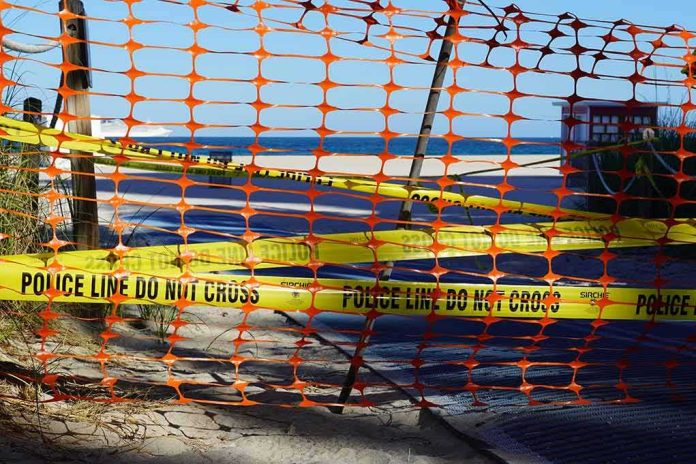
Agencies moved fast to protect the sites. Fencing, warning signs, and round-the-clock monitoring went up around both nests. Officials urged beachgoers to steer clear to improve the odds that the eggs would hatch. They said the protective measures would stay in place through the incubation period. These steps follow a common playbook used on busy coasts when rare or protected wildlife nests appear near crowds and events.
Why This Nesting Is A Big Deal
National Oceanic and Atmospheric Administration and news reports called the nesting a first recorded natural sea turtle nesting event on the United States West Coast. That label raised the stakes for conservation and for city planners. A first-of-its-kind event on a crowded beach draws heavy public attention and pressure on leaders to avoid mistakes. It also invites questions about how much human activity nearby could raise risks to hatch success.
The species involved, the olive ridley, is protected under federal law. That status triggers involvement by national and state wildlife agencies. It also shapes what mitigation looks like on the ground. Barriers, buffers, and monitoring are standard tools. Officials did not say whether one turtle or two created the nests, which leaves some uncertainty in the biological picture. Either way, the rare event demands careful handling.
The Airshow’s Position And The Mitigation Plan
Huntington Beach leaders and event organizers kept the airshow schedule unchanged while making on-the-ground changes. They moved some pedestrian routes, vendor booths, and attractions away from the protected areas. The mayor said the 50-by-50-foot protective barrier around the nest sat outside the main airshow footprint. That claim suggests the city believes the current buffer is enough to reduce risk without a postponement.
This approach reflects how coastal managers often balance competing needs. They first try to create space between people and wildlife and then monitor for problems. If new risks arise, they can add limits. So far, no report shows a direct link between airshow activity and harm to the nests. That gap in evidence does not prove zero risk. It does show why many agencies favor targeted mitigation over canceling events outright at the start.
Where The Science And Uncertainty Meet
Experts say olive ridley eggs incubate buried in sand for weeks. Heat, moisture, compaction, light, and predators can all play roles. Reports here do not include nest-by-nest data on vibration, crowd pressure, or lighting at night. Without that, officials are leaning on standard protections and field checks. One National Oceanic and Atmospheric Administration scientist was quoted saying loud sounds, light, and vibrations have negligible impact on egg development, but that is one view and context matters.
LIFEGUARDS SAW A TURTLE STRUGGLING IN THE SAND AT HUNTINGTON BEACH AND WENT TO RESCUE IT. IT WASN'T DYING. IT WAS LAYING THE FIRST SEA TURTLE EGGS EVER RECORDED ON THE US WEST COAST.
September 16. Night patrol. Huntington Beach, California. Lifeguards spotted a reptile thrashing… https://t.co/JCuUHTCplP pic.twitter.com/NuI2EoV5Od
— Joying.eth (@Joyingeth) September 23, 2026
Both sides point to values many Americans share. People want public beaches open and safe. People also want rare wildlife guarded from harm. The deeper worry cutting across politics is trust. Citizens see agencies and city halls juggle money, noise, and nature and wonder who gets heard. Clear data, transparent updates, and visible buffers can help. If hatch conditions change, officials should be ready to tighten rules. If the buffer works, they should show the proof after hatch time.
Sources:
nypost.com, ocregister.com, new.patch.com, theguardian.com, accuweather.com, yahoo.com, usatoday.com