
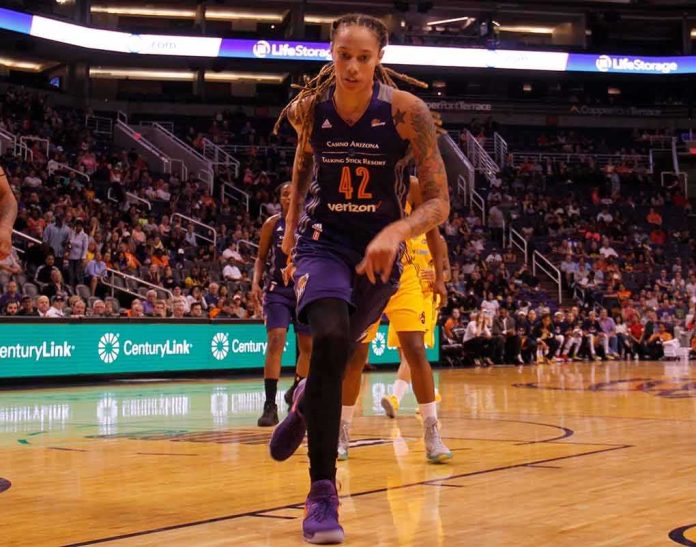
One player comment helped turn the WNBA into a full-blown culture fight, and the fallout spilled far beyond basketball.
Quick Take
- The WNBA has been pulled into a wider culture war after Sophie Cunningham’s remarks on transgender athletes drew national attention.
- Reporting says the dispute led to rallies, counterrallies, and tense fan confrontations at games in Seattle, Portland, and Minnesota.
- Major outlets now describe the league as a recurring stage for culture-war politics, not just sports coverage.
- Recent incidents around the league show how quickly on-court moments can become public fights about gender, race, and identity.
How a basketball dispute became a public flashpoint
The latest wave of controversy started after Indiana Fever guard Sophie Cunningham told ESPN she wanted “to protect young girls in a locker room” and young girls in sport from “biological men.” Reporting says that comment set off an online uproar and pushed the league into another round of culture-war coverage. The story did not stay limited to basketball talk. It quickly moved into politics, media debate, and public protest.
Several outlets say the reaction reached the arena level. Reporting described rallies and counterrallies outside WNBA games in Seattle, Portland, and Minnesota after the Cunningham remarks. That matters because it shows how a player’s comment can become a live public event with security and crowd-control issues attached. The league is now dealing with something larger than one interview. It is managing the way every new flashpoint gets turned into a larger fight.
The league keeps getting used as a symbol
Multiple news reports now describe the WNBA as being inside a “culture war,” and that framing has become hard to avoid. That does not mean the league caused every reaction. It means the league has become a symbol people use to argue about gender, identity, and values. In that sense, the WNBA is being treated less like a sports league and more like a public stage for arguments already raging across the country.
The pattern is bigger than one issue. Recent coverage has also tied the WNBA to other high-profile disputes, including hard fouls, fan harassment, racial abuse, and political comments from public figures. Once that mix takes hold, even routine basketball moments can be read as proof of a larger story. That is why the league’s image now depends not only on wins and losses, but on how it handles every new social and political clash.
What this means for the league’s future
The WNBA’s challenge is not just bad headlines. It is the slow loss of control over its own public story. When every controversy gets folded into partisan debate, the basketball is no longer the main product. Fans who want the league to stay focused on sport see distraction and drift. Fans who care about activism see a league under pressure from every side. Both reactions reflect a deeper frustration with institutions that seem unable to stay in their lane.
I was just on @CBSNews The Takeout with @MajorCBS. I was there to talk about the WNBA – what else.
I was introduced as the head of @xx_xyathletics, "an advocacy organization."
Correction 1: We are an athletic clothing brand. We are not a non-profit. We are a business. A brand.…
— Jennifer Sey (@JenniferSey) August 10, 2026
That frustration is why these incidents keep landing so hard. The league’s growth has brought more attention, but it has also brought more pressure to take sides in disputes that go far beyond the court. The result is a cycle that feeds itself: one comment sparks outrage, outrage draws protest, and protest gives the next controversy even more oxygen. The WNBA now has to prove it can keep basketball at the center.
Sources:
foxnews.com, sports.yahoo.com, cbc.ca, theguardian.com, theringer.com, nytimes.com, republicanpress.org, cnn.com