
Taiwan’s latest combat drills are not theatre; they are the practical expression of a society that has accepted it must live, train, and plan under the shadow of sustained Chinese military pressure.
At a Glance
- Taiwan’s annual Han Kuang and related combat readiness drills now integrate live-fire, rapid mobilization, and civil resilience to prepare for a potential Chinese attack.
- The exercises are explicitly designed against concrete scenarios: amphibious landings, blockades, decapitation strikes, and “gray-zone” coercion short of open war.
- China’s own large-scale drills around Taiwan, framed in Beijing as “retribution” and “justice missions,” amplify the threat environment Taipei is training to withstand.
- Despite detailed public descriptions of scenarios and methods, outside observers still lack hard data on whether these drills measurably improve Taiwan’s combat readiness.
Why Taiwan’s Drills Have Become a Permanent Feature of the Strait
To understand Taiwan’s current drill cycle, you have to start with the environment, not the calendar. Over the past several years China has normalized near-constant military activity around the island: fighters and bombers crossing the median line, warships and coast guard cutters pressing close to offshore islands, and periodic large-scale exercises explicitly rehearsing blockades and strikes. Against that backdrop, Taiwan’s drills are less an episodic response than a continuous adaptation process. The Ministry of National Defense now treats combat readiness as a standing condition rather than an exception; the exercise schedule is the visible part of that shift.
The Han Kuang war games, held annually since the 1980s, sit at the center of this architecture. Recent iterations have expanded well beyond traditional field maneuvers, integrating industrial dispersal, communications resilience, reserve mobilization, and civil-defense protocols. In parallel, the Ministry has introduced shorter, focused “Immediate Combat Readiness Exercises” that run for five days and aim to test how quickly units can move from peacetime posture to wartime footing in the face of sudden Chinese escalation. Taken together, these events amount to a rolling rehearsal of Taiwan’s worst day.
Inside the “Immediate Combat Readiness” Concept
The five-day combat readiness drills that drew international attention are deliberately framed by Taiwan’s defense ministry as realistic, time-compressed tests rather than scripted demonstrations. Officials describe them as “real-time, live-fire, and on-site” exercises, a formulation that matters: it signals that units are expected to react to evolving inputs and incomplete information, mimicking the friction of real combat rather than marching through pre-arranged tableaux. Key metrics inside the system—though not disclosed publicly—include mobilization time, the speed of deployment to defensive positions, and command-and-control continuity under stress.
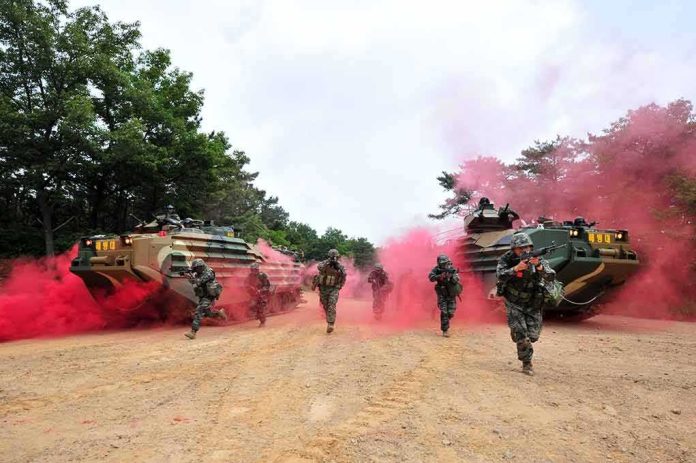
Reporting from within Taiwan gives some texture to what this looks like on the ground. On launch, combat units “immediately began moving to designated defensive positions across the country,” a phrase that reflects a shift from static defense to mobile, distributed postures intended to complicate Chinese targeting. Tanks and mechanized infantry patrol urban areas; artillery and rocket units disperse to pre-surveyed sites; air-defense batteries practice rapid emplacement and relocation. This is not about spectacle for its own sake; it is about compressing the timeline between warning and effective resistance.
Han Kuang: From War Game to Whole-of-Society Stress Test
Han Kuang has always been Taiwan’s largest war game, but its remit has widened as planners confront the reality that modern conflict will not be confined to beaches and airfields. In the current cycle, the defense ministry explicitly plans to test relocating weapons production lines and converting civilian factories for military use if Chinese strikes hit primary supply hubs. That scenario—China cloaks invasion preparations in “routine” drills, then rapidly escalates to bombardment—forces Taiwan to practice fast decisions about dispersal, continuity of production, and protection of critical infrastructure.
Crucially, Han Kuang now runs in parallel with civil-defense and urban resilience drills. Municipal governments coordinate shelter-in-place protocols, partial communications blackouts, and continuity-of-government measures; citizens practice responding to air raid sirens and internet throttling. For the first time, Taiwan will deliberately slow mobile internet speeds during the 10-day drill to see how people communicate when bandwidth is scarce, a direct nod to the likelihood that any serious crisis would involve cyber disruption as well as kinetic attack. The governing assumption is clear: in a protracted conflict, military effectiveness depends on social resilience at least as much as on tactical competence.
Training to Meet China’s Most Probable Attack Vectors
Taiwan’s drills are not generic. They are keyed to a defined threat profile derived from years of Chinese activity and doctrinal signals. Amphibious invasion remains the worst-case scenario, and coastal exercises on the island’s western shoreline—which offers the most plausible landing zones—reflect that. In June, Taiwan’s military conducted a coastal drill simulating the destruction of an invading Chinese force by rockets and artillery along an extended beach sector near Taichung, with reduced preparation time to make the event “more akin to actual combat.” The message is both internal and external: forces must be able to fire effectively under time pressure, and potential invaders should expect contested landings.
Other drills focus on defending key nodes that, if seized, could enable rapid decapitation or logistical strangulation. Exercises near Taipei Port, a critical hub less than an hour from the presidential office, involve marines, coast guard units, and military police practicing coastal mining, missile deployment, and drone surveillance to prevent a sudden strike aimed at the capital’s leadership and connective arteries. Joint defense drills featuring Marine Corps mobilization around the Taipei metropolitan area test whether forces can seal off critical corridors and respond to hostile vessels entering territorial waters. These scenarios mirror Chinese practice, which has included explicit rehearsal of “decapitation” operations and blockade tactics in its own drills.
Chinese Pressure: The Moving Backdrop to Taiwan’s Training
None of this occurs in a vacuum. While Taiwan runs its drills, China runs its own. Exercises such as “Justice Mission 2025” have seen rockets launched north and south of the island, coordinated maneuvers by army, navy, air force, and rocket forces, and simulated encirclement of Taiwan’s key ports. These events often follow political triggers—a speech by Taiwan’s president vowing to “resist annexation,” or an announcement of a major U.S. arms package—and are framed in Beijing as punitive responses to “separatist forces.”
Taiwan’s defense ministry routinely reports dense clusters of Chinese aircraft and ships operating near its airspace and waters during these periods. In one instance, officials tracked 89 Chinese military aircraft and 28 naval vessels, including coast guard ships, prompting activation of missile systems and high alert status. In another, 23 aircraft, seven naval vessels, and five additional government ships approached in the hours around Taiwan’s own combat readiness drills. China’s defense spokesperson calls such operations “justified and reasonable” training to safeguard sovereignty, accusing Taipei of exaggerating war fears. From Taiwan’s vantage point, however, this pattern is exactly why readiness drills must be constant: the line between intimidation and preparation can be perilously thin.
Measuring Readiness: What We Know and What We Don’t
From a distance, it is relatively easy to describe what Taiwan is doing; it is much harder to quantify what it is achieving. Public reporting, whether from Reuters, local outlets, or official statements, provides rich detail on scenario design, locations, and broad objectives. We know that exercises test rapid deployment, industrial dispersal, reserve call-ups, and civil-defense protocols. We can see tanks on city streets, rockets firing from coastal batteries, and citizens practicing shelter-in-place. What we do not see are the underlying numbers: mobilization timelines, command-post activation rates, ammunition distribution speed, or communications uptime under simulated attack.
That opacity is not unique to Taiwan. Defense ministries worldwide guard their readiness metrics and after-action reviews, partly to avoid telegraphing vulnerabilities to adversaries and partly to manage domestic political risk. The result is that external analysts and the public often have to infer readiness gains from the sophistication of drills rather than from audited performance data. When officials say a drill is “more realistic” or “unscripted,” that signals a rejection of past, more ceremonial practices, but it does not automatically prove that units are now capable of sustaining extended combat under heavy fire. For a skeptical observer, the key question remains: are these exercises closing specific capability gaps or simply rehearsing known strengths?
Escalation Risks and Political Perceptions
Taiwan’s leaders present these drills as defensive: an effort to ensure the island can survive, deter, or at least complicate any Chinese attempt at forcible unification. Yet drills themselves are not politically neutral. Because they are explicitly tied to China as the threat, Beijing and some external commentators portray them as escalatory, feeding a narrative that Taipei is “militarizing” the strait. In turn, Taiwan highlights China’s much larger and more aggressive exercises as proof that its own training is a necessary response, not a provocation.
For ordinary Taiwanese, this can create a paradox. On one hand, visible drills—with tanks on roads, sirens sounding, and communications throttled—reinforce the reality of danger and the seriousness of government planning. On the other, the constant drumbeat of military activity risks numbing public attention or generating fatigue, especially when concrete outcomes are hard to see. The government has responded by framing resilience exercises as all-hazard training, relevant for earthquakes and typhoons as well as war, and by stressing that preparedness is a form of peacekeeping: the better Taiwan can endure pressure, the less incentive there is for China to test its defenses.
What These Drills Mean for Taiwan’s Strategic Posture
Viewed as a whole, Taiwan’s current drill regime represents a deliberate move toward a “porcupine” posture: making the island so difficult to subdue quickly that any attacker faces prolonged, costly conflict. Live-fire coastal defenses complicate amphibious landings; industrial dispersal raises the threshold for crippling Taiwan’s arms production; civil-defense rehearsals increase the chances that government and society can function under bombardment and cyber disruption. In strategic terms, these are all about buying time—time for Taiwan to reconstitute forces, for allies to make political decisions, and for China’s leadership to confront the economic and military costs of escalation.
Whether the drills are sufficient is another question. Without access to internal performance data, outsiders cannot say with confidence that Taiwan can withstand a sustained blockade or multi-week missile campaign. What the exercises do show, however, is that Taiwan is aligning its training with the most probable threat vectors and attempting to build depth in both military and civilian systems. In a security environment where China’s pressure has become a near-daily fact, that alignment is itself a meaningful indicator of strategic maturity. The island is not just signaling resolve; it is learning, iterating, and rehearsing for scenarios it hopes never to face, but cannot afford to ignore.
Taiwan began major military drills on Wednesday to test commanders' ability to fight on the fly when enemy movements defy expectations, while temporarily limiting internet access for the first time, senior Taiwan officials said. https://t.co/vc6AHF5agu
— Reuters China (@ReutersChina) August 6, 2026
Sources:
washingtonpost.com, reuters.com, youtube.com, taipeitimes.com, focustaiwan.tw, brusselsmorning.com