

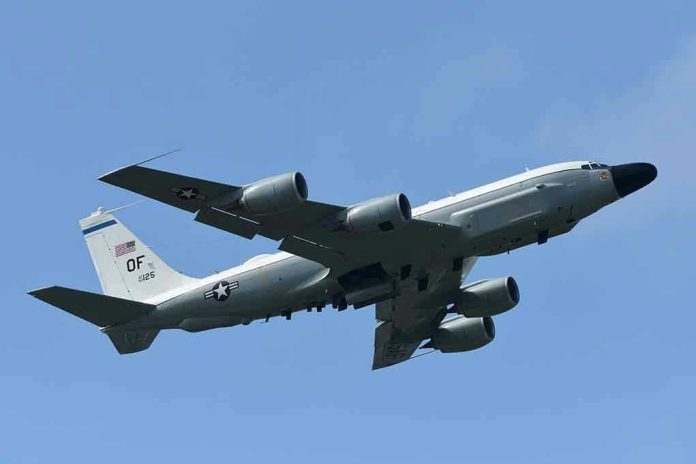
The Air Force just awarded Boeing a massive $2.04 billion contract to breathe new life into America’s legendary B-52 Stratofortress fleet, ensuring our strategic bomber remains a cornerstone of national defense well into the 2050s.
Quick Take
- Boeing receives $2.04 billion to re-engine two B-52H test aircraft with advanced Rolls-Royce F130 engines by 2033
- Program addresses critical engine obsolescence threatening B-52 fleet sustainability by 2030
- New engines will dramatically improve fuel efficiency, reliability, and electrical power for advanced weapons systems
- Testing phase precedes full fleet modernization of all 76 B-52s, extending service life to 2050s
Strategic Investment in American Air Power
The December 23, 2025 contract award represents a crucial step in preserving America’s long-range strategic deterrent capability. Boeing Defense Systems will lead the Commercial Engine Replacement Program post-Critical Design Review development, focusing initially on two B-52H aircraft modifications and testing. The work spans multiple sites including Oklahoma City, San Antonio, Seattle, and Indianapolis, supporting American defense jobs while strengthening our military industrial base. This targeted approach allows thorough validation before fleet-wide implementation.
Addressing Critical Engine Obsolescence
The current Pratt & Whitney TF33-PW-103 engines powering the B-52H fleet face severe sustainment challenges due to diminished manufacturing support and component obsolescence. These engines, introduced in the 1960s, are projected to become unsustainable by 2030, threatening the operational readiness of our strategic bomber force. The new Rolls-Royce F130 engines offer similar size, weight, and thrust characteristics while providing modern reliability and fuel efficiency. This transition addresses a critical national security vulnerability before it becomes a crisis.
Enhanced Capabilities for Modern Warfare
Beyond solving obsolescence issues, the engine replacement program significantly enhances B-52 operational capabilities. The F130 engines will provide improved fuel efficiency, extended range, and increased loiter time over target areas. Enhanced electrical power generation supports integration of advanced weapons systems and modern avionics. Combined with ongoing radar modernization efforts featuring AESA technology, these upgraded aircraft will receive the B-52J designation, representing a substantial capability leap for nuclear and conventional missions.
The modernization timeline extends through May 31, 2033, for the initial two-aircraft testing phase. Air Force Global Strike Command expects operational B-52J aircraft before decade’s end, with the full fleet upgrade following successful testing validation. This measured approach ensures taxpayer dollars are invested wisely while maintaining the rigorous safety standards required for nuclear-capable aircraft. The program represents smart stewardship of defense resources, extending proven platform utility rather than pursuing costly new aircraft development.
Strengthening Defense Industrial Base
The contract bolsters American aerospace manufacturing across multiple states, creating high-skilled jobs in Oklahoma, Texas, Washington, and Indiana. Port San Antonio serves as a key modification site, highlighting Texas’s growing role in defense manufacturing. This geographic distribution strengthens supply chain resilience while supporting local communities dependent on defense industry employment. The partnership between Boeing and Rolls-Royce demonstrates successful integration of American prime contracting with allied supplier relationships, maintaining technological edge while supporting domestic production capabilities.
Aviation industry experts universally praise this modernization effort as essential for maintaining America’s strategic deterrent credibility. The B-52’s proven combat record spanning decades justifies continued investment over unproven alternatives. With global tensions rising, extending the Stratofortress’s service life through the 2050s provides stable, cost-effective deterrent capability that potential adversaries must respect and account for in their strategic calculations.
Sources:
USAF Awards Boeing $2B Contract for B-52 Re-Engining Program
Boeing Awarded $2 Billion Contract for B-52 Engine Replacement
Boeing B-52 Bomber Modernization US Air Force
Boeing B-52 Port San Antonio Pentagon $2B Contract
Boeing to Re-Engine B-52 Fleet to Extend Service Life
The Legendary B-52 Gets a New Lease on Life with New Engines and an AESA Radar